The Enlightenment organized doubt rather than inventing it. The thinkers of the seventeenth and eighteenth centuries inherited a long tradition of skeptical inquiry, running from the pre-Socratics through Pyrrhonism to Renaissance humanism, and gave it institutional form: universities, academies, journals, a shared method. At its best it was among the most fruitful intellectual advances the West had produced.
The difficulty is what came after. Intellectual revolutions, like the traditions they displace, are capable of producing their own orthodoxies. Working from texts alone in a world almost entirely unexcavated, thinkers of the period reached sweeping conclusions about Scripture. Spinoza, in the Tractatus Theologico-Politicus (1670), argued that the Bible's transmission history was "not so much imperfect as untrustworthy: the foundations are not only too scanty for building upon, but are also unsound," laying the groundwork for treating Scripture's major figures as literary constructions. Two centuries later, Julius Wellhausen systematized that suspicion: his Prolegomena (1878) argued that the Pentateuch was a late composite assembled by priestly editors to serve political ends, its earlier layers reflecting a primitive stage of religious evolution. Condorcet's Sketch (1795) supplied the broadest conclusion, looking forward to a time when "priests and their stupid or hypocritical instruments will exist only in works of history and on the stage." These conclusions arose from real problems in how religious institutions handled knowledge, history, and authority, and several of them were necessary correctives.
But they were formed under conditions of radical informational scarcity. Archaeology as a discipline barely existed, comparative linguistics was embryonic, and the manuscript traditions of the ancient Near East were almost entirely inaccessible. Whole civilizations attested in the biblical record lay unexcavated beneath the soil of Turkey, Iraq, and the Levant. Absence of evidence was taken, systematically, as evidence of absence.
That assumption has since been falsified repeatedly. The question this article puts to inherited skepticism is simple: which of those conclusions still stand?
The Unexcavated World
The Hittites were among the great powers of the ancient Near East, rivals to Egypt, architects of sophisticated treaty structures, authors of international correspondence recovered from the Egyptian city of Akhetaten. Wellhausen's school dismissed them. The higher-critical program that had declared the Pentateuch a late fabrication treated the absence of external corroboration as confirmation: no independent record of the Hittites had been found, and a people described extensively in the Hebrew Bible was therefore assumed to be invented, an inference K. A. Kitchen would later characterize as absence of evidence mistaken for evidence of absence.
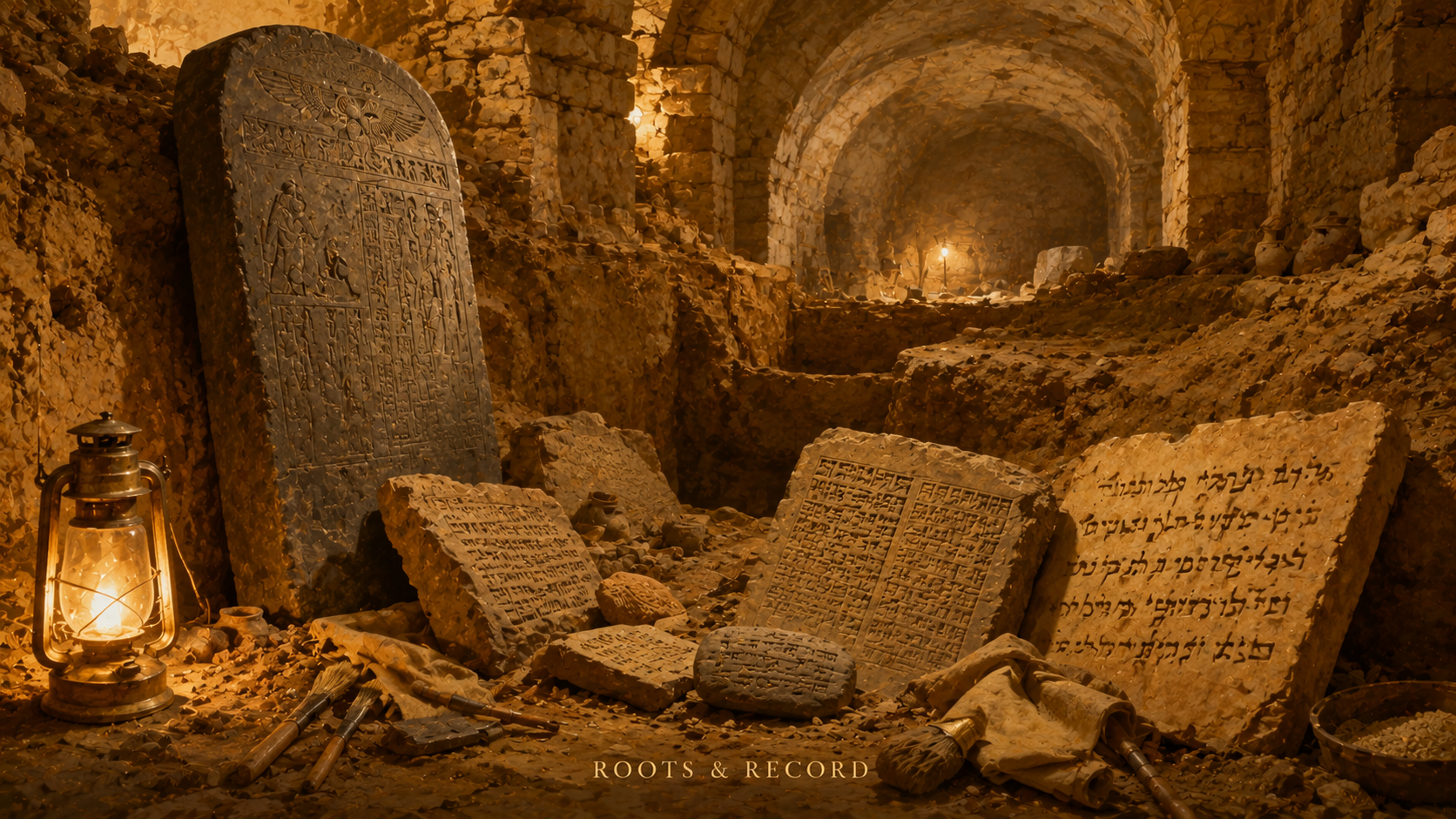
The excavation of the Hittite capital Hattusa, beginning in the late nineteenth century, revealed an empire of considerable complexity: archives in multiple languages, diplomatic records, legal codes, mythological texts. It demonstrated decisively that the biblical accounts of Hittite interaction with Israel and Judah were historically grounded. The rediscovery of Nineveh followed a similar arc. Dismissed as fiction before Austen Henry Layard's excavations in the 1840s, the Assyrian capital yielded the royal library of Ashurbanipal: tens of thousands of cuneiform tablets, among them flood narratives, creation accounts, and administrative records that transformed the study of the ancient Near East.
These recoveries established a methodological principle the higher-critical school had inverted. The world of the Hebrew Bible had a dense, recoverable material history. The silence that had licensed so many confident dismissals was the silence of the unexcavated.
Israel Is Laid Waste
In 1896, the British archaeologist Flinders Petrie discovered a black granite stele in the mortuary temple of Pharaoh Merneptah at Thebes. Standing over three meters tall and inscribed in twenty-eight lines of hieroglyphic text, it commemorates Merneptah's military campaigns in Libya and Canaan around 1208 BCE. Near the end of the inscription, among a list of defeated peoples, appears a phrase that would become one of the most discussed lines in ancient Near Eastern scholarship. In the translation of James Pritchard's Ancient Near Eastern Texts, the relevant passage reads:
Canaan is plundered with every evil; Ashkelon is carried off; Gezer is captured; Yanoam is made non-existent; Israel is laid waste, its seed is no more.
The stele, held today at the Egyptian Museum in Cairo, carries a detail of singular importance: Israel appears with a hieroglyphic determinative marking it as a people rather than a city-state or a territory. An Egyptian pharaoh, in a victory inscription composed for propaganda, recorded the existence of a people called Israel in Canaan in the late thirteenth century BCE. This is the earliest known extra-biblical reference to Israel in any ancient inscription, and it was written by an adversary.
Wellhausen's preferred dating of the biblical narratives placed the emergence of Israel far later than the thirteenth century BCE. The Merneptah Stele placed Israel in Canaan precisely there, centuries before his reconstruction could accommodate. It retired one question about Israelite origins without resolving them all.
The House of David
In 1993, the archaeologist Gila Cook, working under the direction of Avraham Biran at Tel Dan in northern Israel, discovered a basalt fragment bearing an Aramaic inscription. Three fragments were eventually recovered, constituting a ninth-century BCE victory stele erected by an Aramean king, almost certainly Hazael of Damascus, recording military triumphs over the kingdom of Israel and its southern neighbor. The inscription is housed at the Israel Museum in Jerusalem.
Line nine of the inscription contains the phrase bytdwd, transliterated byt dwd and read by most scholars as "House of David." The expression designates the Judahite royal dynasty by its founder's name, exactly as the Hebrew Bible uses it throughout the books of Kings and in the prophetic literature. An Aramean king, composing a monument to his own victories, named David's dynasty the ruling power in the south.
Before 1993, minimalist scholars had argued with some confidence that David was a literary construction, a theological archetype with no historical referent. The Tel Dan inscription settled the question of David's existence as a dynastic founder without settling every question about his reign. His name, in the form his successors used to identify themselves, appeared on stone carved by his enemies.
The Exodus and the Limits of Silence
The higher-critical treatment of the Exodus was straightforward: no Egyptian record attests to it, therefore it lacks historical grounding. This remains the strongest point in the skeptical case, and it deserves a direct answer rather than evasion.
Egypt commemorated its victories. Royal monuments celebrated military success, and administrative records documented logistics. Catastrophic reversals, of which Egyptian history has several, are largely absent from the official record because the genre of royal inscription did not accommodate them. The absence of an Egyptian Exodus account is consistent with a culture whose commemorative conventions systematically excluded defeat.
Archaeology has recovered a broader context supporting the historical plausibility of the biblical setting. Semitic populations are attested in the eastern Nile Delta during the Second Intermediate Period, when Hyksos rulers of Semitic origin controlled Lower Egypt. Forced labor on state construction projects is extensively documented in Egyptian administrative records, including in the same Delta region where the biblical tradition locates Israelite settlement. The site of Tell el-Borg and the broader evidence from the Wadi Tumilat suggest a sustained Semitic presence in precisely the geography the biblical account describes. This evidence establishes that the world the narrative describes was real, though it does not confirm the Exodus as narrated.
The Scroll That Changed the Calculation
The assumption that the biblical text had been substantially corrupted in transmission rested on a reasonable inference. Before the mid-twentieth century, the oldest Hebrew manuscripts available to scholars were medieval: the Aleppo Codex dates to around 920 CE, the Leningrad Codex to 1008 CE. Separated from the texts' putative origins by more than a millennium, they seemed to offer limited grounds for confidence about what earlier versions had contained.
Between 1947 and 1956, scrolls were recovered from caves near Qumran, on the northwestern shore of the Dead Sea. They included manuscripts of every book of the Hebrew Bible except Esther, dating to the second and first centuries BCE, more than a thousand years older than any previously known Hebrew text. When scholars compared the Great Isaiah Scroll (1QIsaa) to the medieval Masoretic text underlying most modern translations, the degree of continuity was striking: the text corresponded with a fidelity that revised the corruption thesis at its root. The finding was continuity, which is precisely what Wellhausen's framework had no room for. The Israel Antiquities Authority's digital collection makes the Great Isaiah Scroll available in full.
A Text Critiquing Itself
The sharpest problem with the higher-critical account of Scripture is the one least frequently named: it proceeded as though critical intelligence were arriving from outside a closed and credulous system. The Hebrew Bible does not support that reading.
The prophetic literature is a sustained internal assault on Israel's religious and political establishment. Amos, a shepherd from Tekoa writing in the eighth century BCE, addresses the prosperous elite of the northern kingdom with unconcealed contempt. Their religious festivals are noise, their offerings an offense, their prosperity built on the exploitation of the poor; the God they invoke at the sanctuaries is not impressed. "I hate, I utterly loathe your festivals; I take no pleasure in your solemn assemblies" (Amos 5:21). Job carries the internal critique further: the friends who supply the tidy theodicy of the age, that suffering is punishment and restoration is reward, are told at the close of the book that they have not spoken rightly, as Job has (Job 42:7). The man who argued with God is vindicated over the men who defended God's reputation. Ecclesiastes sits within the wisdom literature as a sustained meditation on wisdom's own limits: "Vanity of vanities, saith the Preacher, vanity of vanities; all is vanity" (Ecclesiastes 1:2), a skeptical conclusion reached inside the canon and included by those who assembled it.
The tradition that assembled these texts made the deliberate choice to include books that destabilize easy conclusions about divine reward, cultic efficacy, and the reliability of received wisdom. That is a more rigorous intellectual culture than Wellhausen's account allowed for, and it was already there.
The Misread Target
The critics' target was Scripture, but Scripture read through a specific lens: centuries of Christian theological interpretation conducted at a significant remove from the Jewish textual world in which those texts had originated. Serious engagement with rabbinic literature, with the midrashic tradition, with the Talmudic culture of argument and counter-argument, was largely absent from the major figures of biblical criticism in this period.
The Talmud is a record of dispute, a centuries-long argument in which minority opinions are preserved alongside majority ones, debates remain unresolved across generations, and the editors were not permitted by the tradition to adjudicate every question. The famous ruling that "these and these are the words of the living God," applied to two schools whose positions directly contradict each other, captures something essential about the tradition's intellectual culture. The tradition enshrined dissent.
When Voltaire or Spinoza attacked Scripture's historical reliability, they were often attacking readings that Jewish scholarship had already complicated, qualified, and contested across generations. The target was, in significant part, a Christianity that had domesticated Jewish texts into a Greek philosophical framework and defended them with institutional authority. That target was real, and it warranted the critique it received. The textual tradition itself was another matter entirely.
Hume, Galileo, and the Philosophical Residue
Two of the period's most influential philosophical arguments against religion, Hume on miracles and the science-religion conflict thesis, deserve brief attention, though they occupy a different register from the historical and archaeological questions above.
Hume's argument deserves to be taken seriously on its own terms, and the institutional context that generated it deserves acknowledgment. The Church had spent centuries demanding assent to miracle claims as a condition of social standing, suppressing dissent by authority and weaponizing the supernatural against inquiry. When Hume turned the tools of empiricism against miracle testimony, the instinct was honest and the provocation real. His argument in Section X of the Enquiry Concerning Human Understanding is precise: "A miracle is a violation of the laws of nature; and as a firm and unalterable experience has established these laws, the proof against a miracle, from the very nature of the fact, is as entire as any argument from experience can possibly be imagined." Where the argument overreaches is in treating a philosophical premise as an empirical result. Science describes patterns of observable regularity; it does not adjudicate what is metaphysically possible within or beyond those patterns. Hume's framework assumes the closure of the natural order, and that assumption lies outside empirical method, unable to be established by the same uniform experience Hume invokes to establish it.
The science-religion conflict thesis has fared no better with historians of science. The Galileo affair, most frequently cited in its support, has been substantially revised by John Hedley Brooke, whose Science and Religion argues that the story "results in a caricature when abstracted from its historical context." Galileo's confrontation with the Church involved competing scientific models, philosophical assumptions on both sides, and the politics of patronage and publication. Brooke's study across several centuries finds a complex and often collaborative history. The conflict thesis, taken as a general account, is bad history dressed as settled wisdom.
Conclusions Worth Reopening
The skeptical project of this period was honest and provisional, formed under conditions of informational scarcity that no longer obtain. The problem is that several of its conclusions stopped being treated as provisional long before the evidence changed.
An epistemology that draws conclusions from silence in an unexcavated world and then resists revision when the world is excavated is inherited assumption wearing skepticism's clothes. The Hittites existed; Israel appears on Egyptian stone in the thirteenth century BCE, and David's dynasty on Aramean basalt in the ninth. The biblical text was transmitted with a care the corruption thesis cannot accommodate, the prophetic tradition was internally critical centuries before Wellhausen arrived, and the rabbinic culture of argument was already doing, with greater sophistication, what the higher critics claimed to be introducing.
To reopen these questions is to apply to Enlightenment conclusions the same standard the Enlightenment applied to everything else. That standard requires revising conclusions when the evidence changes. On the questions surveyed here, the evidence changed substantially.
This is Part One of a two-part series. Part Two, The Discipline of Doubt, examines what modern skepticism gets right, and why, applied consistently, it leads to a more honest and demanding engagement with the evidence rather than to settled disbelief.
Sources
Primary Texts
Scripture quotations are from the King James Version (KJV).
The Great Isaiah Scroll (1QIsaa), Dead Sea Scrolls Digital Project, Israel Antiquities Authority. Available at deadseascrolls.org.il.
Merneptah Stele (c. 1208 BCE), Egyptian Museum, Cairo. Online record: egypt-museum.com.
Tel Dan Stele (9th century BCE), Israel Antiquities Authority / Israel Museum, Jerusalem. Online record: imj.org.il.
Secondary Literature
Brooke, John Hedley. Science and Religion: Some Historical Perspectives. Cambridge: Cambridge University Press, 1991.
Condorcet, Marquis de. Sketch for a Historical Picture of the Progress of the Human Mind (1795).
Hoffmeier, James K. Israel in Egypt: The Evidence for the Authenticity of the Exodus Tradition. Oxford: Oxford University Press, 1997.
Hume, David. An Enquiry Concerning Human Understanding (1748), Section X.
Kitchen, K. A. On the Reliability of the Old Testament. Grand Rapids: Eerdmans, 2003.
Mazar, Amihai. Archaeology of the Land of the Bible, vol. 1. New York: Doubleday, 1990.
Pritchard, James B., ed. Ancient Near Eastern Texts Relating to the Old Testament, 3rd ed. Princeton: Princeton University Press, 1969.
Spinoza, Baruch. Tractatus Theologico-Politicus (1670). Available at archive.org.
Tov, Emanuel. Textual Criticism of the Hebrew Bible, 3rd ed. Minneapolis: Fortress Press, 2012.
Vermes, Geza. The Complete Dead Sea Scrolls in English, rev. ed. London: Penguin, 2004.
Wellhausen, Julius. Prolegomena to the History of Israel (1878). Available at gutenberg.org.